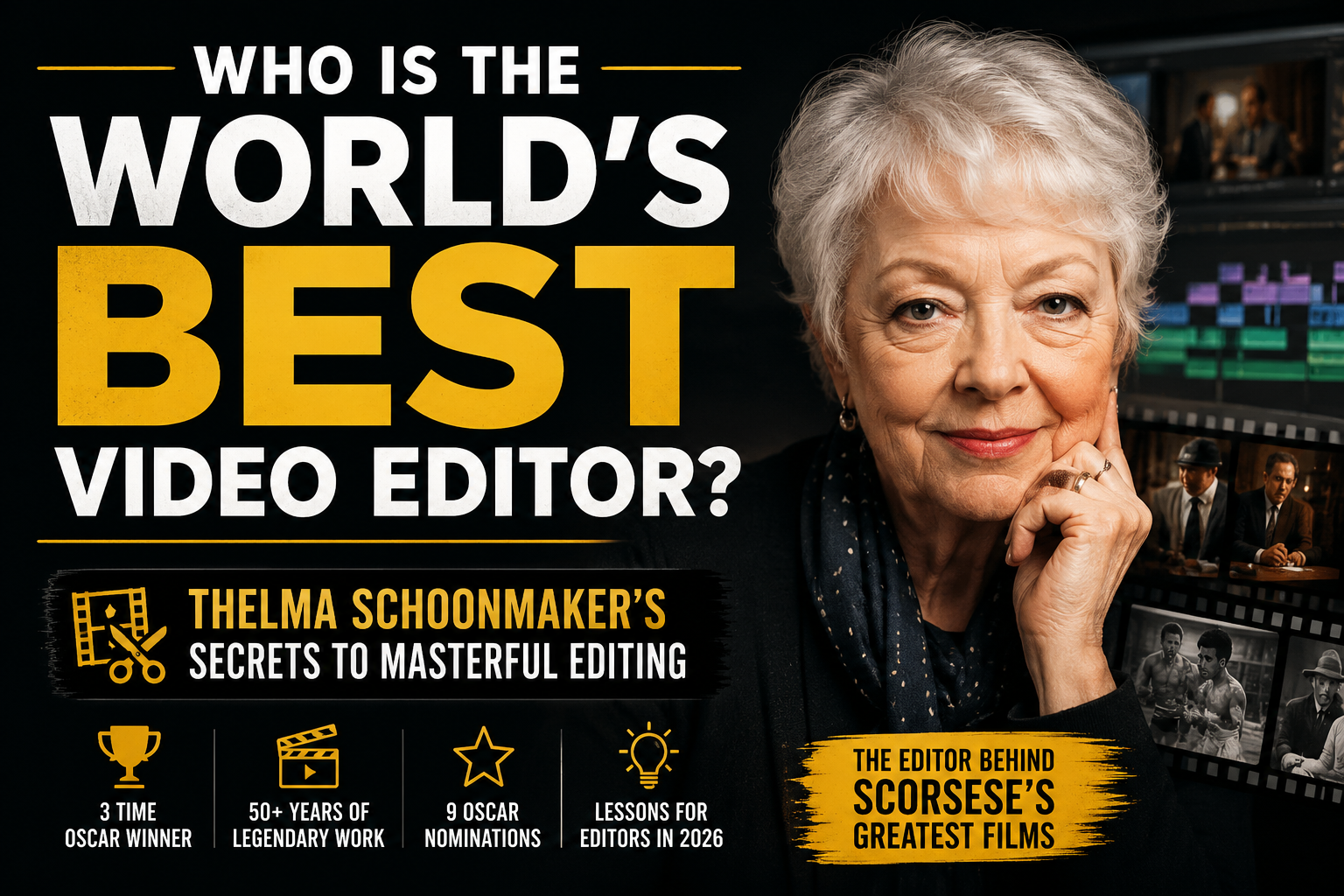
Who Is the World’s Best Video Editor? The Ultimate Guide to the Greatest Editors in History (2026)
Quick Answer
If you’re looking for the world’s best video editor, most film professionals and critics would point to Thelma Schoonmaker. Her work on films such as Raging Bull, Goodfellas, The Departed, The Irishman, and Killers of the Flower Moon has earned multiple Academy Awards and helped define modern film editing.
However, the answer depends on how we define “best.” Hollywood film editing, YouTube editing, commercial editing, documentary editing, and social media editing all require different skills.
This guide explores why Thelma Schoonmaker is often considered the greatest editor of all time, examines other legendary editors, and reveals the lessons modern creators can apply to their own work.
Why Video Editing Matters More Than Most People Realize
When audiences watch a great movie, YouTube video, documentary, or commercial, they often praise the actors, director, cinematography, or visual effects.
What they rarely notice is the editing.
Yet editing is the invisible force that determines:
- How a story feels
- When viewers become emotional
- Whether suspense works
- How long people stay engaged
- Whether a video feels professional
Without editing, even the most expensive footage becomes a collection of random clips.
Editors transform raw footage into compelling stories.
For this reason, many industry professionals believe editing is the most important part of post-production.
Who Is Thelma Schoonmaker?
Thelma Schoonmaker is an American film editor widely regarded as one of the greatest editors in cinematic history.
She began working with Martin Scorsese during the early stages of his career and eventually became one of the most influential creative partners in Hollywood.
Over the decades, she developed a reputation for:
- Exceptional pacing
- Emotional storytelling
- Dynamic action sequences
- Character-focused editing
- Narrative rhythm
Unlike editors who rely heavily on flashy transitions, Schoonmaker’s work focuses on story and emotion.
Her editing serves the audience rather than drawing attention to itself.
Thelma Schoonmaker’s Major Career Achievements
Academy Awards
She has won multiple Oscars for:
- Raging Bull
- The Aviator
- The Departed
Oscar Nominations
She has received numerous Academy Award nominations across several decades.
This level of consistency is almost unheard of in the film industry.
Long-Term Collaboration
Few editor-director partnerships have been as successful as:
Thelma Schoonmaker + Martin Scorsese
Their collaboration spans more than fifty years.
Why Many Experts Call Her the Greatest Editor Ever
1. Story Before Technology
Many editors focus on software.
Great editors focus on storytelling.
Schoonmaker consistently prioritizes:
- Character development
- Emotional impact
- Narrative clarity
before visual tricks.
2. Masterful Pacing
Pacing determines how a film feels.
Too slow and audiences become bored.
Too fast and they become confused.
Schoonmaker’s films often maintain engagement for hours without losing momentum.
3. Emotional Precision
The best editors understand human psychology.
A single frame removed from a scene can change how viewers feel.
Schoonmaker is famous for finding exactly the right emotional moment to cut.
4. Adaptability
Her editing style evolves depending on the story.
Compare:
- Goodfellas
- The Departed
- The Irishman
Each feels completely different despite sharing the same editor.
The Top 10 Greatest Film Editors of All Time
1. Thelma Schoonmaker
Known for:
- Goodfellas
- Raging Bull
- The Departed
2. Walter Murch
Known for:
- Apocalypse Now
- The Godfather Part III
- The English Patient
Famous for creating influential editing theories still taught today.
3. Michael Kahn
Known for:
- Jurassic Park
- Saving Private Ryan
- Schindler’s List
Steven Spielberg’s long-time editor.
4. Dede Allen
Known for:
- Bonnie and Clyde
- Dog Day Afternoon
A pioneer who changed modern editing techniques.
5. Anne V. Coates
Known for:
- Lawrence of Arabia
Responsible for one of cinema’s most famous cuts.
6. Sally Menke
Known for:
- Pulp Fiction
- Kill Bill
- Inglourious Basterds
Quentin Tarantino’s legendary editor.
7. Pietro Scalia
Known for:
- Gladiator
- Black Hawk Down
Master of action editing.
8. Joe Walker
Known for:
- Dune
- Arrival
- Blade Runner 2049
One of the most respected modern editors.
9. Lee Smith
Known for:
- Inception
- Dunkirk
- Interstellar
Christopher Nolan’s frequent collaborator.
10. William Reynolds
Known for:
- The Godfather
- The Sting
A major influence on modern editing.
Best Video Editors on YouTube Today
Hollywood and YouTube require different skills.
Some of the most respected YouTube editors include:
- Hayden Hillier-Smith
- Sam Kolder
- YB Editing
- Devin Graham’s editing team
These editors specialize in:
- Retention optimization
- Fast pacing
- Social media storytelling
- Viral content structures
Hollywood Editing vs YouTube Editing
| Hollywood Editing | YouTube Editing |
|---|---|
| Story-focused | Retention-focused |
| Long-form content | Short-form content |
| Emotional arcs | Immediate hooks |
| Cinema pacing | Rapid pacing |
| Theatrical audience | Digital audience |
Both require strong storytelling fundamentals.
The Editing Techniques That Made Thelma Schoonmaker Famous
Rhythm Editing
Every scene has a rhythm.
Great editors cut according to emotional flow rather than arbitrary timing.
Reaction-Based Cutting
Often the most important shot isn’t the action itself.
It’s the reaction afterward.
Story Compression
Editors remove unnecessary moments.
This keeps audiences engaged.
Visual Continuity
Good editing feels invisible.
Viewers stay immersed in the story.
What Modern Video Editors Can Learn From Thelma Schoonmaker
Focus on Story First
Software does not make someone a great editor.
Storytelling does.
Remove More Than You Keep
Professional editors often discard most footage.
Study Human Psychology
Understanding emotions improves editing more than learning another transition pack.
Practice Daily
Editing is a craft developed through repetition.
Can AI Become the World’s Best Editor?
AI tools now assist editors with:
- Auto-cutting
- Captions
- Color correction
- Audio cleanup
- Scene detection
Popular tools include:
- Adobe Premiere Pro AI
- DaVinci Resolve AI
- CapCut AI
- Descript
- Runway
However, AI still struggles with:
- Emotional storytelling
- Creative judgment
- Narrative structure
- Audience psychology
For the foreseeable future, AI will augment editors rather than replace them.
How to Become a World-Class Video Editor
Learn One Professional Software
Choose:
- Adobe Premiere Pro
- DaVinci Resolve
- Final Cut Pro
Master one before learning others.
Study Great Films
Watch films edited by:
- Thelma Schoonmaker
- Walter Murch
- Michael Kahn
Analyze every cut.
Build a Portfolio
Clients care more about results than certificates.
Create projects consistently.
Learn Storytelling
The best editors are storytellers first and technicians second.
Frequently Asked Questions
Who is considered the world’s best video editor?
Most experts consider Thelma Schoonmaker the greatest film editor in history due to her influence, awards, and body of work.
Who is the highest-paid video editor?
Top Hollywood editors and post-production specialists can earn hundreds of thousands of dollars per project.
Can AI replace video editors?
AI can automate technical tasks but cannot fully replace creative storytelling.
Is video editing a good career in 2026?
Yes. Demand continues to increase across film, YouTube, advertising, online education, and social media.
What software do professional editors use?
Adobe Premiere Pro, DaVinci Resolve, Final Cut Pro, and Avid Media Composer remain industry standards.
Final Verdict
There is no official ranking that determines the world’s best video editor.
However, if one name consistently appears at the top of conversations among filmmakers, critics, and editors, it is Thelma Schoonmaker.
Her work demonstrates that editing is not about transitions, effects, or software. It is about storytelling, emotion, and understanding how audiences experience a narrative.
That lesson remains just as valuable in 2026 as it was fifty years ago.